It is difficult to select the right mobile development partner. Thousands of firms provide iOS and Android services, so there is a lot to review. Price matters, of course, but you should also look at technical expertise, industry experience, security practices, and the company’s reliability over time.
Here, we provide a straightforward comparison of four established mobile development companies. We cover their service offerings, technical expertise, and real track records. After the profiles, we’ve included a practical checklist of questions. You can use it to conduct your own vendor assessment.
Top 4 Proven Mobile App Developers
We’ve selected four mobile app development companies that have proven themselves over time. The choice came down to technical expertise, industry reputation, client reviews, and the variety of services they offer.
For each company, we put together a profile. You’ll get an overview, their core services, and key measurable strengths. Look through these carefully. Then see which vendor fits your project needs, your industry, and your budget.
1. Geniusee
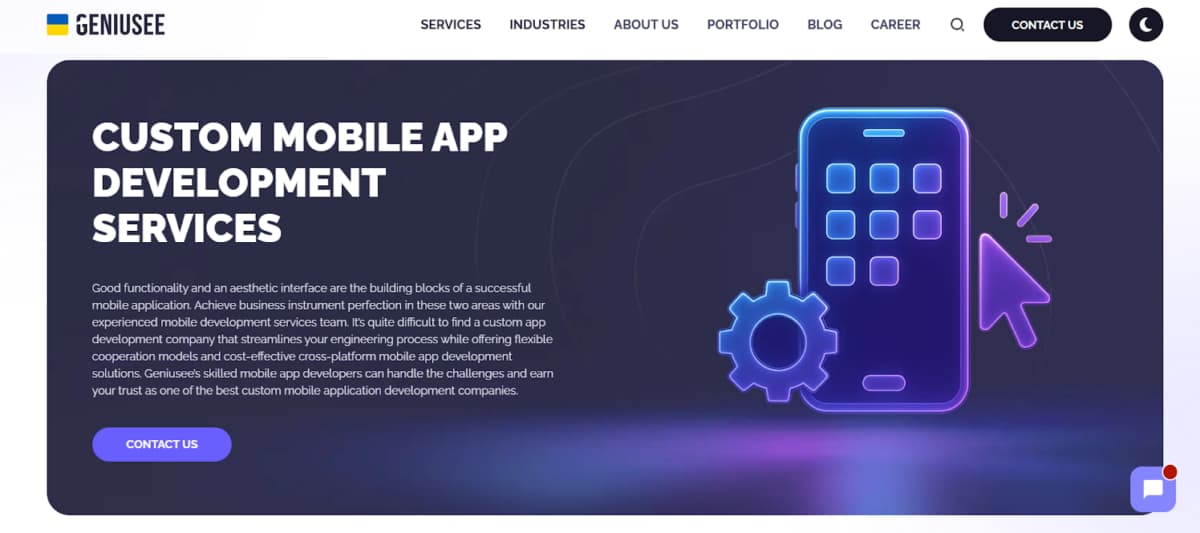
Founded in 2017, Geniusee is a global custom mobile development firm with over 300 professionals that has delivered more than 180 mobile projects across FinTech, EdTech, Retail, Manufacturing, and Real Estate.
The company hold key certifications including AWS Advanced Tier Service Partner, ISTQB Platinum Partner, ISO 9001, and ISO 27001.
Core Services
Geniusee builds native iOS apps. They use Swift and Objective-C. Everything follows Apple’s Human Interface Guidelines. For Android, they go with Kotlin and Java. The focus there is on responsive UX and strong security. They also do hybrid development with React Native. That’s usually when a client wants to get to market faster.
Beyond that, here are a few other things they offer: AI-driven personalization with predictive analytics. 5G connectivity and IoT orchestration for real-time data coordination. And legacy upgrades — meaning they take older codebases and move them to SwiftUI or Jetpack Compose.
Key Strengths
- Ranked #14 on the 2025 Clutch 1000 list. That’s out of over 400,000 vendors. Also recognized as a Top 5 Software Developer on Clutch;
- Offers three flexible engagement models: dedicated teams, staff augmentation, and sprint-based support;
- Achieves a 99.9% on-time delivery rate.
2. Capgemini
Capgemini Government Solutions (CGS) works with federal agencies to develop secure and reliable mobile apps. They incorporate AI, virtual reality, and other new technologies while focusing on solutions that align with mission goals and serve citizens effectively.
The company applies DevSecOps methodologies across the full development process. As a result, their apps meet high security standards and achieve successful ATO outcomes more easily.
Core Services
Capgemini helps federal agencies with mobile app development that incorporates AI, VR, and other advanced tools. They put special emphasis on security integration so that apps meet tough standards and earn ATO approval.
Beyond that, they provide cross-platform apps that run consistently across devices, mobile experiences designed to increase citizen engagement, and architecture solutions built to satisfy federal security and compliance rules.
Key Strengths
- Brings extensive experience in architecting mobile solutions for complex federal systems;
- Enables agencies to innovate, improve performance, and reduce technical debt;
- Delivers breakthrough citizen mobile experiences that support always-on innovation.
3. DXC
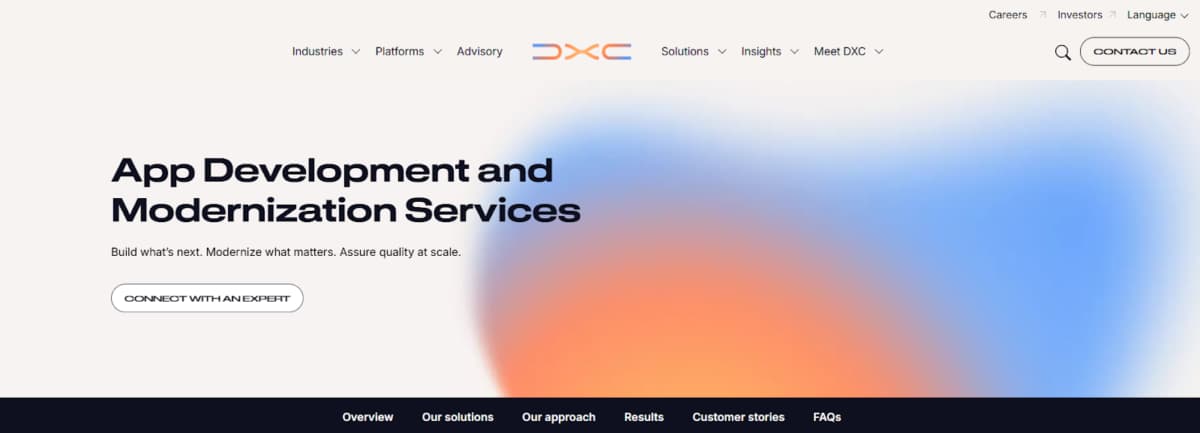
DXC Technology partners with enterprises to design, build, and maintain mobile applications that keep their operations running smoothly. They combine strong engineering practices with AI, automation, and secure-by-design principles.
From the early idea stage all the way to cloud-native deployment and continuous support, DXC handles the full complexity of mobile development. The company has modernized more than 2 billion lines of code in its modernization factory. Today, they manage over 20,000 applications worldwide and maintain an impressive 99.84% migration success rate.
Core Services
DXC provides mobile software development focused on cloud-native, API-first applications using DevSecOps and AI-assisted engineering with built-in security and observability. The company offers mobile application modernization by rearchitecting existing apps to cloud-native architectures and modernizing backend integrations.
Mobile quality engineering services include end-to-end testing, AI-powered automation, and consumption-based Testing-as-a-Service. DXC also delivers cross-device mobile assurance to validate functionality, performance, and security across real-world usage scenarios.
Key Strengths
- Delivers accelerated mobile releases up to 50% faster with Lean-Agile and DevOps practices;
- Achieves 30% application cost reduction through automation;
- Reduces testing time by 50% with approximately 40% cost savings through intelligent automation.
4. Atomic Object
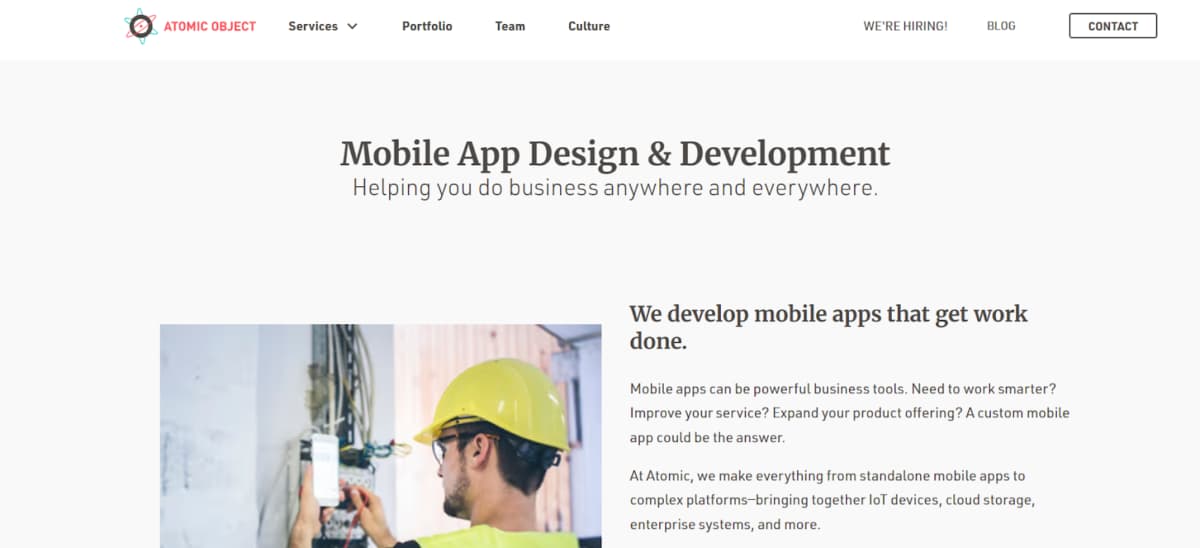
Atomic Object creates custom mobile apps that range from straightforward standalone solutions to quite complex platforms. These apps often connect IoT devices, cloud storage, and enterprise systems in a clean, uncomplicated way.
The team really prioritizes building apps that are built to last, intuitive to use, and deliver strong ROI. They’re known for hitting deadlines while staying on budget. With solid experience across Android, iOS, and cross-platform technologies, Atomic Object also helps clients make practical technology decisions that fit their actual business goals and financial situation.
Core Services
Atomic Object provides Android app development that works smoothly across a wide variety of devices and OS versions, as well as iOS app development with integration for Bluetooth Low Energy, NFC, Augmented Reality, and geotracking. The company offers cross-platform mobile development using React Native that runs securely on both iOS and Android from a single codebase.
Additional services include mobile IoT integration using embedded software, Bluetooth Low Energy, MQTT, NFC, and Zigbee, plus mobile backend development for content management, cloud storage setup with Azure or AWS, and integration with ERPs or enterprise data systems.
Key Strengths
- Has built sophisticated mobile apps for both consumer and enterprise use cases;
- Offers responsive web apps as an economical alternative for content-heavy mobile experiences;
- Ensures mobile app ecosystems safeguard information while providing smooth, reliable experiences;
- Maintains a strong track record of on-time and on-budget delivery.
Key Questions to Ask Before Choosing a Mobile Development Partner
The right questions make all the difference. Take time to ask these during your evaluation:
Do you have real experience in my industry?
Whether it’s FinTech, healthcare, retail, or government work, relevant experience cuts down on mistakes and speeds everything up. Ask to see similar projects they’ve completed.
What engagement models do you offer?
Find out if they do dedicated teams, staff augmentation, or sprint-based work — and how easily the team can grow or shrink as your needs change.
What security and compliance certifications do you have?
Depending on your project, look for things like ISO 27001, SOC 2, HIPAA, or federal clearances.
How do you approach native versus cross-platform development?
Do they push Swift and Kotlin for performance, or React Native and Flutter for faster delivery? Make sure their recommendation actually fits your goals.
Can you share real results from past projects?
Ask for actual numbers — faster load times, fewer crashes, better uptime, or how many users the app supported at once. Skip the vague answers.
How do you handle legacy app modernization?
If you have an older app, ask about moving it to modern frameworks like SwiftUI or Jetpack Compose.
What does your testing and quality assurance process look like?
Good teams use real devices, automated testing, and check how the app performs across different OS versions and screen sizes.
How do you work with newer technologies like AI, IoT, or 5G?
If these matter to your project, confirm they’ve actually built similar features before.
What kind of support do you offer after launch?
Apps need regular updates and bug fixes. Get clear details on maintenance agreements upfront.
Can you connect me with past clients?
Especially ones with similar project size and timeline. A quick call with them often tells you more than any proposal.
Conclusion
At the end of the day, selecting a mobile development partner is a big decision. You’re not just buying code — you’re choosing who you’ll work with for months.
The four firms we profiled each bring different things. Full custom development with solid outcomes. Federal-level security. Enterprise modernization expertise. And user-centered design that plays well with IoT.
No one company works for every project. Pick the one that fits your industry, security needs, budget, and expected support.
Go through the questions we suggested. Talk to them. Reach out to their clients. Double-check their numbers.
Put in the effort now. It will show up later in how smoothly your app runs, how protected it is, and how fast it reaches users.