Enterprise AI stopped being an experiment. It now drives core operations at many firms. But most companies still bolt AI on as a separate layer rather than building it into their systems. This approach fails more often than it succeeds.
Success depends on integrating AI into your processes, data pipelines, and architecture. Below, we break down companies with different approaches to enterprise AI. Each one fits a different stage of maturity.
Where Enterprise AI Breaks in Practice
AI usually breaks at the integration and infrastructure level, not the model level. You can have a perfect algorithm. It won’t matter if your data pipelines collapse or your workflows reject the output.
These mistakes repeat regardless of budget or team size. Our team has seen the same patterns at Fortune 500 companies and funded startups alike. The failures look different on the surface but share the same structure underneath. Most enterprise AI failures follow the same patterns:
- Disconnected AI models from business workflows;
- Weak data pipelines that break under load;
- Overfocus on experimentation instead of deployment;
- Poor integration with existing systems;
- Lack of cost control and scaling strategy.
These errors only become visible at scale. By then, fixing them costs ten times more than prevention would have.
What Real Enterprise AI Execution Looks Like
Strong teams build AI as part of the system, not as a feature bolted on the side. The technology needs to disappear into workflows. Users shouldn’t know they’re interacting with AI.
Real execution connects models to business outcomes from day one. The difference between demo and production is always infrastructure. Always. Key elements include:
- Clear connection between AI and business outcomes;
- Robust data infrastructure and pipelines;
- Scalable architecture from day one;
- Integration with core systems and workflows;
- Continuous optimization and cost control.
These capabilities form the baseline for AI systems that actually scale in production.
Top Companies Delivering Enterprise AI Solutions
The companies below take different paths to enterprise AI. Some lead with data infrastructure. Others focus on automation or consulting. Each approach fits specific problems and stages of maturity.
Matching the right partner’s strengths to your current stage doubles your chances of building AI that actually delivers business value. A startup needs different capabilities than a Fortune 500 bank. Know where you stand before you start evaluating.
1. Geniusee
Geniusee builds enterprise AI systems that ship to production, not just Jupyter notebooks. Their focus on data infrastructure and cloud architecture solves the real reason enterprise AI fails: broken data pipelines under real load. The team has delivered over 180 projects since 2017, holds AWS Advanced Tier status, and works with Databricks for data engineering.
They ask about your business model before discussing any AI stack. Geniusee AI development services show how they think about AI as part of business systems, not a separate track. Companies that choose Geniusee stay for years because the infrastructure scales without constant expensive rewrites.
Core Capabilities and Integration Approach
Geniusee structures work around data first, then AI capabilities. Their teams ask about your existing workflows before suggesting any automation. This prevents building impressive models that nobody actually uses. Our analysts have seen this mistake wipe out enterprise AI budgets repeatedly. Their approach builds AI into real processes from the start. Core capabilities include:
- Generative AI integration and prompt engineering;
- AI-driven automation for business workflows;
- Enterprise AI architecture and cloud infrastructure;
- NLP and conversational AI solutions;
- Computer vision and advanced analytics systems.
This approach builds production-ready systems, not proof of concepts that gather dust.
Best Fit for Enterprise AI Projects
Geniusee fits enterprise products, platforms, and automation projects. Their model works well when you have clear business problems and an existing data infrastructure. Works poorly for organizations still figuring out whether they need AI at all or teams without dedicated data engineering resources.
2. Cognizant
Cognizant delivers enterprise AI at massive scale. Their clients include global banks, manufacturers, and healthcare systems. The company focuses on automation and GenAI integration into existing enterprise workflows. Their strength lies in handling compliance-heavy industries where AI mistakes cost real money. They have deployed AI solutions across more than 40 countries, navigating regulatory frameworks that change by region. This global footprint matters when your AI system must work in both the EU and Southeast Asia without running afoul of local rules.
AI and Automation Capabilities
Cognizant prioritizes business processes before AI model selection. Their teams map automation opportunities before discussing model selection. This prevents building solutions that look for problems. Our analysts have seen this reverse approach save months of wasted effort. Key strengths include:
- Enterprise AI implementation at scale;
- Business process automation using AI;
- Generative AI solutions for enterprise workflows;
- Integration with legacy systems;
- Cloud-based AI deployment models.
- Scale and compliance drive everything they do.
Best Fit for Large Enterprises
Cognizant fits Fortune 500 companies and regulated industries. Their model works when you have existing enterprise systems that need AI augmentation, not replacement. Less suitable for startups or mid-market firms without complex compliance requirements.
3. Turing
Turing provides AI engineering teams on demand. Their model focuses on LLM integration and rapid deployment of generative AI features. The company has built a global network of vetted AI engineers who work remotely. Their screening process accepts less than 1% of applicants, which means you get engineers who have already passed technical bars that would take you months to evaluate yourself.
Engineering and AI Delivery Model
Turing scales AI engineering capacity up and down based on project needs. Their engineers specialize in LLM integration and prompt engineering for production systems. This model works well for companies with an internal AI strategy but lacking execution bandwidth. Their delivery focuses on speed without sacrificing quality. Core capabilities include:
- LLM integration and prompt engineering;
- AI engineering teams on demand;
- Scalable AI infrastructure development;
- Automation using generative AI;
- Rapid deployment of AI features.
Speed matters when you need to ship AI features before competitors.
Best Fit for Fast Scaling AI Teams
Turing fits companies with a clear AI strategy but limited internal engineering capacity. Their model works well for funded startups and enterprise innovation teams that need to move faster than their hiring pipeline allows. Less suitable for organizations still defining what they want to build or teams without internal technical leadership to manage remote engineers. Bring a clear roadmap and a tech lead who can review work. Otherwise, you pay for velocity without direction.
4. DataRobot
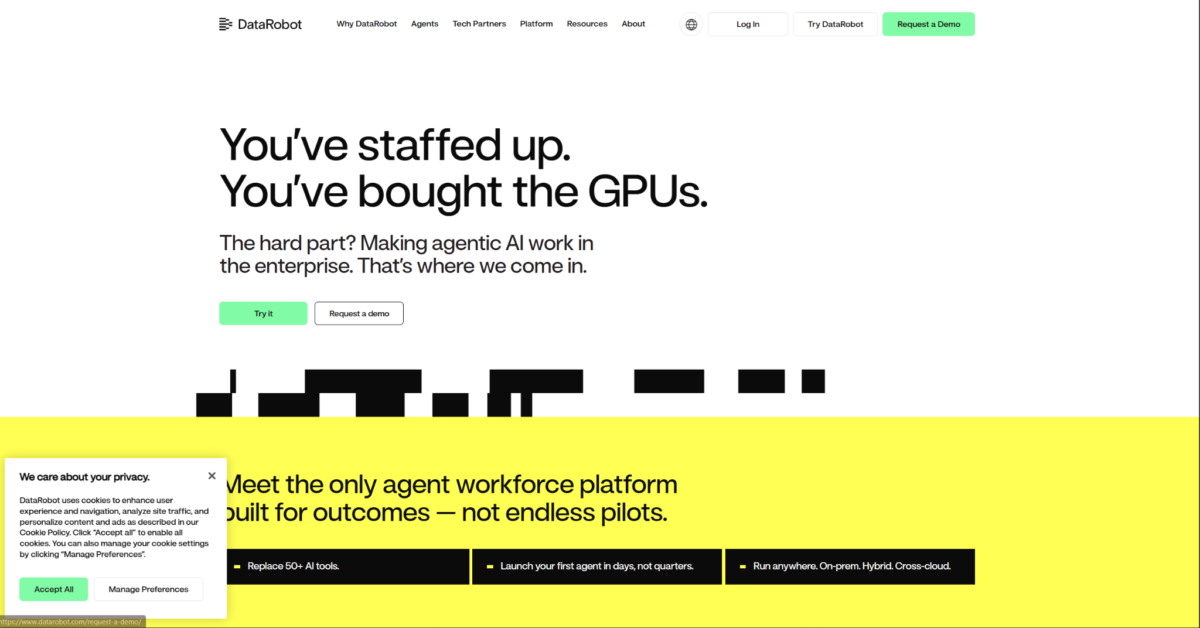
DataRobot provides an enterprise AI platform for automated machine learning and model deployment. Their tools help organizations build, deploy, and monitor AI models without deep data science teams. The biggest bottleneck in enterprise AI is not model quality but deployment speed. DataRobot solves this by automating the steps that usually take months of manual work. Companies using their platform go from idea to production in weeks, not quarters.
AI Platform and Automation Capabilities
DataRobot automates the repetitive parts of ML workflows. Their platform handles data prep, model selection, and deployment monitoring. This works best for organizations with data scientists who want to move faster, not replace them. The platform includes governance features for regulated industries. Core capabilities include:
- Automated machine learning systems;
- AI model deployment and monitoring;
- Data pipeline automation;
- Predictive analytics solutions;
- Enterprise-grade AI governance.
Platforms beat point solutions when you need to scale AI across multiple teams.
Best Fit for Data-Driven Organizations
DataRobot fits companies with existing data science teams who need to accelerate delivery. Their model works when you have clean data and clear use cases. Less suitable for organizations without structured data or analytics maturity. If your data lives in PDFs, fix that first. Bring clean tables, not messy spreadsheets.
5. Fractal
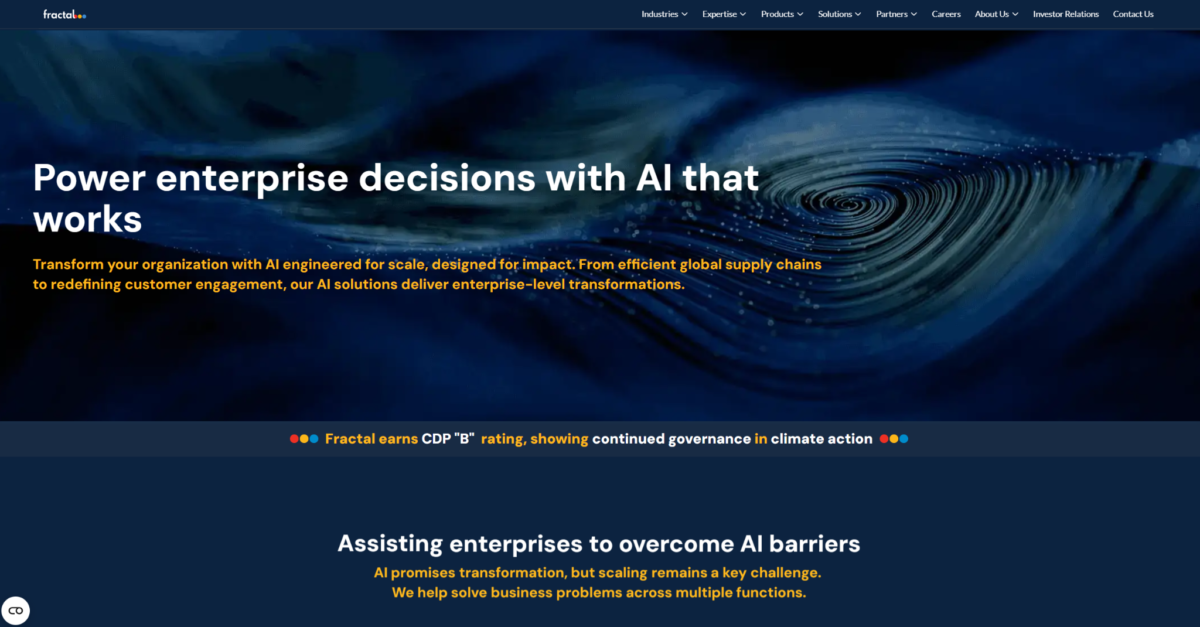
Fractal Analytics focuses on AI-driven decision systems for enterprise clients. Their background in data science and NLP runs deep. The company serves the financial services, retail, and healthcare industries. Most AI vendors stop at dashboards and visualizations.
Fractal goes further by building systems that actually make or recommend decisions. This matters because insights without action generate zero ROI. Their clients include several Fortune 100 companies where AI drives millions of daily operational choices.
Advanced AI and Data Capabilities
Fractal builds AI systems that drive operational decisions, not just dashboards. Their teams combine data science with domain expertise. This matters more in complex industries where off-the-shelf models fail. They focus on explainable AI for regulated environments. Core capabilities include:
- Generative AI and NLP solutions;
- Advanced data science and analytics;
- AI-driven decision systems;
- Customer behavior modeling;
- Enterprise AI integration.
Decisions, not insights, drive ROI from AI investments.
Best Fit for Data Intensive Businesses
Fractal fits companies where AI must drive operational decisions, not just reports. Banks, insurers, and large retailers fit this profile. The best results come when you have complex decisions happening at scale today. Less suitable for organizations without a mature data infrastructure. Bring operational data and real decisions, not slide decks about what AI could maybe do.
How to Select the Right AI Development Partner
Wrong partner choice creates losses you cannot see up front. You sign a contract. Six months later, you realize the architecture won’t scale, or the models don’t integrate. This mistake costs enterprises 8 to 12 months of rework.
Use these criteria to evaluate partners. Don’t trust case studies alone. Ask about failed projects and why they failed. Key decision criteria include:
- Experience with enterprise AI systems;
- Ability to integrate AI into workflows;
- Strong data infrastructure expertise;
- Scalability and cost optimization approach;
- Alignment with business objectives.
These criteria separate partners who deliver production systems from those who deliver slide decks.
Final Thoughts
Enterprise AI works when you build systems, not feature lists. The technology amplifies good strategy but cannot fix broken foundations. Choose a partner whose approach matches your maturity stage and problem set. That decision determines whether your AI investment drives operational advantage or becomes another expensive lesson. Companies that rush partner selection spend twice as long fixing avoidable mistakes. Vet properly upfront. Your infrastructure will thank you when models hit production.